
As we are all embracing the golden weather, I cannot think of a better dish than this braised beef recipe. It's got it all: hearty beef sauce, seasoned with a special spice mix, served over pasta. This traditional Greek 18th-century recipe called "Pastitsada" comes right from the island of Corfu.

Jump to:
- The history behind the recipe
- The recipe and its secrets
- The meat: beef, rooster, or chicken
- The #1 secret ingredient for the sauce
- The #2 secret ingredient for the sauce
- Two more special ingredients
- The pasta is bucatini
- The Greek braised beef recipe
- Expert tips
- How Greeks serve this braised beef dish
- What about leftovers
- How to store and freeze
- More traditional Greek dishes with beef
- Recipe
Tender beef slowly simmered in red wine, Greek-style sauce. It doesn't contain tomato but another ingredient which I won't reveal yet-evil grin-). It's a simple Sunday-family-get-together meal that smells incredible, and it tastes even better. Serve over hot bucatini pasta with freshly grated parmesan cheese or Greek kefalotiri. Place on a big platter right in the middle of the Sunday table and enjoy an over two-century-old dish with family and friends.

The history behind the recipe
You are here only for the recipe? No problem. Jump to Recipe. The rest of you find out the origins of this delicious dish.
Corfu (Κέρκυρα = Kerkira in Greek) is a beautiful island located in northwestern Greece, with Albania to the north and Italy across the Adriatic Sea. The proximity to Italy greatly influenced the local culture, mostly because the island was a possession of the Republic of Venice from the mid-14th century until the late 18th century. The influence on cuisine is more than obvious in every aspect: ingredients, cooking techniques, and Italian-sounding names.
It is believed that pastitsada originates from a traditional Venetian dish called "pastissada or pastizzada de caval," which is essentially a horse meat stew. (Back then, I suppose, facing famine, any meat could be considered food. Let's not judge by the standards of our time of prosperity.)
In Corfu, pastitsada is made with beef or rooster. Keep in mind that it is an ancient recipe, in a time when the tomato was considered exotic and mostly poisonous, at least until the mid-19th century. The first pasta recipe with tomato was documented in Italy in 1839, and I suppose it took a while until tomatoes took hold as an important ingredient in Italian and Greek homes.
As a consequence and in respect of the recipe's history, there will be no tomato on our plates but another ingredient. I am still not going to reveal it (evil grin - twice!).

The recipe and its secrets
To begin with, I tasted this amazing dish at a friend's dinner party. She is an excellent cook, and her family's origin comes from Corfu. She made pastitsada with rooster, and I really loved the meat sauce and the spice mix. It was absolutely perfect. I complimented her on the dish, and she told me about its history.
I was especially intrigued when she told me that the old version doesn't contain tomato, but the sauce remains thick, rich, and equally, if not more flavorful. Challenge accepted! I would dare to replicate a recipe much older than the 18th century. So glad I did it! Another delicious Mediterranean recipe on the family's rotation.
The meat: beef, rooster, or chicken
It is up to you. It's delicious with every kind of meat. My kids prefer beef, my hubby prefers rooster or chicken, and I am like Switzerland, so I make all versions to satisfy both sides. What can I say? I was born to please 🙂
Just a reminder that the best cut for this beef recipe is chuck. It's a cheap cut, with excellent flavor and the appropriate fat to make it a very appealing choice for a hearty meat dish. Please don't choose a lean cut. It would be delicious because of the tasty sauce, but the meat won't be tender, and it's going to be a complete waste of time and money.
The #1 secret ingredient for the sauce
Old-time favorite onion! Brilliant cooking with basic ingredients, guys! Give it a try! Create the first sweet layer and give body to your meat sauce with the simplest of ingredients.
When I say add onion, I mean a lot of onion, like "no way to add that much in a dish," and then you add some more of it!

The #2 secret ingredient for the sauce
Now, I hear you saying: "This recipe sounds too basic to my liking!". Well, I know my audience. You like bold, full-flavored dishes with real-food ingredients. Mediterranean cooking spoils our taste buds and makes us search for better, bolder, tastier recipes to exceed the last perfect dish. In all sincerity, it's exhausting, but it's totally worth the trouble.
That being said, this recipe stands out from the other meat sauce dishes because of its spice mix. In Corfu, it is called "spetseriko" (from the Italian word "spezia" meaning spice). Every household has its spice mix for this recipe, which is like a family secret kept well-sealed and passed down to the new generations.
Alternatively, even today, you may find this special blend of seasoning in grocery stores on the island. Convenient, right? Nevertheless, there is a small problem. You have to travel to Corfu or at least to Greece to get it. I couldn't find it online for overseas delivery. But…
As always, I have you covered…again. I am super excited to post the spice mix for your braised beef with pasta. I've tested the recipe twice and finally adjusted the spice mix to my clan's taste: it is as spicy as it can be to serve to children and other picky eaters. Neither of the 6 ingredients stands out. This is very important because there are people who cannot stand cinnamon or cloves in their food. I strongly suggest giving it a try and using it in other dishes with meat, like moussaka, stuffed eggplants, and definitely add it to your makaronia me kima, which is bolognese sauce with pasta. It makes a huge difference for a special dish.
So, here it is. My spice mix contains the following ingredients:

Two more special ingredients
THE DRY RED WINE
The majority of braised meat sauces use broth or water. Not this one.
Pastitsada relies on dry red wine-and the quality matters. Choose a bold, dry Greek wine (like Agiorgitiko or Xinomavro) or something equally robust. Avoid anything labeled "cooking wine" or overly sweet blends. The wine isn't just for deglazing-it's essential to the braising process, enriching the sauce and tenderizing the meat. A poor-quality wine can leave the dish flat or super sour. If you wouldn't drink it, don't cook with it.
Don't be afraid to serve it to children because alcohol has plenty of time (over 1 ½ hours) to cook off. The vinegar contains minimal traces of alcohol so it is safe as well.
THE VINEGAR
Use a good-quality red wine vinegar with a standard 6% acidity (A Greek brand called ΤΟΡ is reliable and well-balanced). If you don't know the acidity of your vinegar, add just a small splash to the sauce, taste, and adjust gradually. Vinegar in pastitsada is there to bring brightness and depth, not to overwhelm the dish. Too much-or using a harsh, overly acidic vinegar-can ruin the balance of flavors. Always taste as you go.
The pasta is bucatini
Hard to miss this unique pasta. It's the one with the big hole, and the Italians call it "bucatini". The trademark hole is the reason that it pairs so well with hearty sauces, especially meat sauces.
Even though the traditional pastitsada calls for bucatini, you may serve it over your favorite pasta. Of course, you can serve it with any kind of grain like rice, bulgur, buckwheat, barley, quinoa, etc.
The Greek braised beef recipe
For the most tender cut of beef, follow my method and you won't regret it.
STEP #1
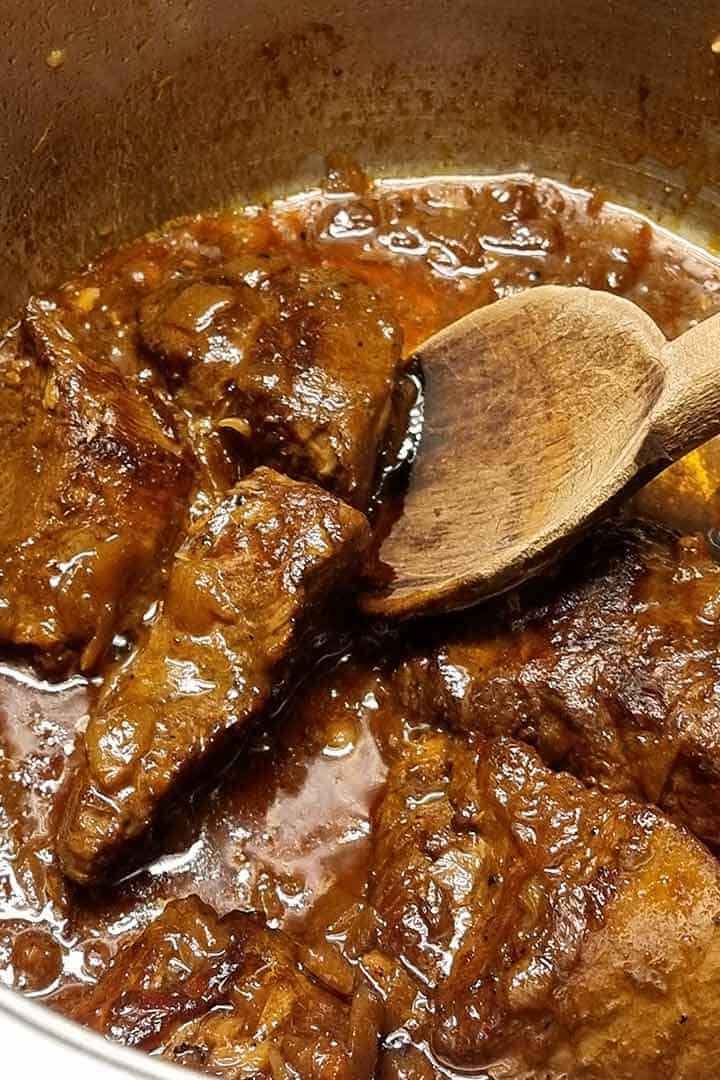
Heat a large heavy-bottomed pot over medium-high heat and sear the beef in batches on both sides.

STEP #2
Add the onions until translucent, and then the garlic and all the spices. Deglaze your pot with a splash of wine and scrape up with a wooden spoon. Add the beef back into the pot and then pour in the wine and vinegar.

STEP #3
Cover with the lid and simmer on medium-low heat for 1 hour. Uncover and season with salt and pepper to taste. Don't add too much pepper because it is already kind of spicy. Simmer a little more until the meat is tender. Ready!
Expert tips
Always use dry red wine-Greek varieties like Agiorgitiko or Xinomavro are ideal.
A splash of good-quality red wine vinegar (6% acidity) adds depth. Add slowly and taste as you go.
Pastitsada is actually better made ahead-the spices and wine develop beautifully overnight. Cook it fully, let it cool, and store it in the fridge for up to 2-3 days. When you're ready to serve, reheat gently over low heat while you boil fresh pasta. It's the ultimate plan-ahead comfort food-rich, ready, and waiting.
How Greeks serve this braised beef dish
Another important part of the recipe is sharing it with friends and family. It is an excellent dish for big get-togethers and special occasions like Christmas, Thanksgiving, or just a weeknight meal.
10 minutes before serving, make the pasta, set it on a big platter, and top it with the meat. When everyone is seated at the table, place the platter in the middle. Oh my! Lots of "wows" and "AAAA" all over the table! Allow yourself to brag because you deserve it! It is such an impressive meal. It is even tastier when you share it with your loved ones.
Don't forget the cheese. It goes so well with the meat-pasta meal. Parmesan or Greek Kefalotyri or your favorite cheese for pasta, freshly grated over the plates, skipping those who don't want any.
This Sunday or festive get-together meal would be epic, along with homemade bread or/and pita bread, spicy feta dip, a traditional cabbage salad, a spinach pie, and lots of wine! Preferably red, like Agiorgitiko, an excellent Greek wine to pair with meat.

What about leftovers
Leftovers = pure gold. Reheat gently over low heat while you boil fresh pasta or other grains. The sauce will be even richer after resting. Perfect for a lazy weeknight or when you need a little festive flashback. And yes, bragging rights still apply the next day.
How to store and freeze
Store in an airtight food container (or leave it in the pot like I do-less washing!) for 2-3 days in the fridge. Reheat on low heat for about 15 minutes while you boil pasta.
To freeze: Let cool completely, then freeze for up to 3 months. Thaw overnight in the fridge, reheat gently, and serve. The flavors stay bold, the meat stays tender.
More traditional Greek dishes with beef
Here are some more dishes with beef as the main ingredient. As always, these dishes are traditional recipes tested through several generations.


If you make this recipe, you have to let me know! I absolutely love your feedback. This is a huge motivation for me and it keeps 30daysofgreekfood's kitchen alive. Bookmark this recipe and leave your rate and comment below, or take a photo with your Braised Beef Recipe and tag me on Instagram with #30daysofgreekfood and Facebook with @30daysofgreekfood.
Recipe

Braised Beef Recipe - Greek Pastitsada
Ingredients
- 2 pounds (1kg) boneless beef, preferably chuck, cut into pieces
- 1 pound (500g) bucatini pasta
- ½ cup (120ml) olive oil
- 2 big onions, finely chopped
- 3-4 garlic cloves, grated
- 2 bay leaves
- 2 cups (500ml) dry red wine*1
- ½ cup (120ml) red wine vinegar*2
- ½ teaspoon sugar (optional)
The Spice Mix
- 1 teaspoon paprika
- ½ teaspoon ground cinnamon
- ½ teaspoon ground nutmeg
- ½ teaspoon cumin
- ½ teaspoon ground hot paprika
- 5 whole cloves
For serving (optional)
- Grated parmesan or Greek Kefalotiri
- Parsley or basil
Instructions
- Heat a large heavy-bottomed pot over medium-high heat and sear the beef in batches on both sides. Don’t overcrowd the pot. Set aside in a plate or bowl.
- Reduce heat to medium and add the onions until translucent about 5-8 minutes. Stir well. Add the garlic and all the spices, and sugar (optional) for another 2 minutes. Adjust heat if necessary.
- Deglaze your pot with a splash of wine and scrape up with a wooden spoon. Stir the beef back into the pot and pour in the wine.
- Add a small splash of vinegar to the sauce, and taste. Adjust the vinegar quantity gradually to your liking. If the vinegar is too strong, you need less than the mentioned quantity.
- Stir everything and bring the sauce up to a boil. Add the bay leaves. Cover with the lid and simmer on medium-low heat for 1 hour. Stir occasionally. If it thickens before the beef is ready, add some water or broth.
- Uncover and season with salt and pepper to taste. Don’t add too much pepper because it is already spicy. Simmer for about half an hour or until the meat is tender. Remove the bay leaves and the cloves. Taste and adjust the seasoning if needed.
- In the meantime, cook the pasta in salted boiling water according to package instructions. Drain and drizzle with a little olive oil.
- Serve pasta on a big platter or on individual plates and top with the beef and plenty of grated cheese. You may add parsley or basil (optional).
Notes
- Pastitsada relies on dry red wine, and the quality matters. Choose a bold, dry Greek wine (like Agiorgitiko or Xinomavro) or something equally robust. Avoid anything labeled “cooking wine” or overly sweet blends. The wine isn’t just for deglazing—it’s essential to the braising process, enriching the sauce and tenderizing the meat. A poor-quality wine can leave the dish flat or super sour. If you wouldn’t drink it, don’t cook with it.
- Use a good-quality red wine vinegar with a standard 6% acidity (A Greek brand called ΤΟΡ is reliable and well-balanced). If you don't know the acidity of your vinegar, add just a small splash to the sauce, taste, and adjust gradually. Vinegar in pastitsada is there to bring brightness and depth, not to overwhelm the dish. Too much—or using a harsh, overly acidic vinegar—can ruin the balance of flavors. Always taste as you go.
Leave a Reply